

CENTRAL LIBRARY

Welcome to Online Public Access Catalogue (OPAC)

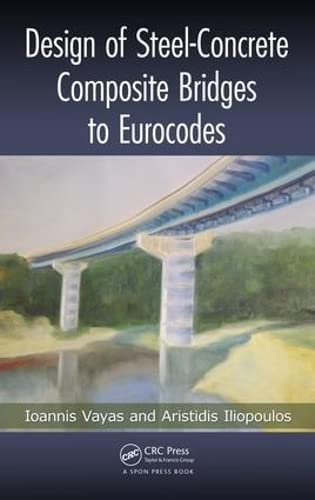
Amazon cover image
Image from Amazon.com

Design of steel-concrete composite bridges to eurocodes / Ioannis Vayas and Aristidis Iliopoulos.

By: Contributor(s): Material type: TextPublisher: Boca Raton : CRC Press, [2014]Description: 1 online resource : text file, PDFContent type:
  • text
Media type:
  • computer
Carrier type:
  • online resource
ISBN:
  • 9781466557451 (ebook : PDF)
Subject(s): Genre/Form: Additional physical formats: Print version:: No titleOnline resources: Available additional physical forms:
  • Also available in print format.
Contents:
1. Introduction -- 2. Types of steel-concrete composite bridges -- 3. Design codes -- 4. Actions -- 5. Basis of design -- 6. Structural materials -- 7. Modeling and methods for global analysis -- 8. Buckling of plated elements -- 9. Ultimate limit states -- 10. Serviceability limit states -- 11. Fatigue -- 12. Shear connection -- 13. Structural bearings, dampers, and expansion joints.
Summary: Preface: "Bridges have a strong symbolism as they connect opposite sides. It is not a coincidence that bridges are illustrated on one side of Euros. For many engineers, bridge design assumes top priority in their practice. In fact, the design of the optimal, technical, economical, and aesthetical solution with existing tools and means is a challenge for any structural engineer. International best practices show that the search for alternative solutions and the choice of the optimal one are essential for the construction of a successful bridge. The criteria for selection may be governed by technical, economical, operational, aesthetical, and environmental considerations and may be the choice of either the owner, the contractor, the designer, or the user. As a result, bridge construction builds a healthy competition as regards structural types, construction materials, construction methods, and other parameters that result in a polymorphy of bridges. In some aspects, bridges reflect the technological development in a period or in a country. Among the different types of bridges, composite bridges have a significant place, because the combination of the most common construction materials, steel and reinforced concrete, allows the construction of safe, operational, durable, and robust bridges economically"-- Provided by publisher.
Tags from this library: No tags from this library for this title. Log in to add tags.
No physical items for this record

Includes bibliographical references and index.

1. Introduction -- 2. Types of steel-concrete composite bridges -- 3. Design codes -- 4. Actions -- 5. Basis of design -- 6. Structural materials -- 7. Modeling and methods for global analysis -- 8. Buckling of plated elements -- 9. Ultimate limit states -- 10. Serviceability limit states -- 11. Fatigue -- 12. Shear connection -- 13. Structural bearings, dampers, and expansion joints.

Preface: "Bridges have a strong symbolism as they connect opposite sides. It is not a coincidence that bridges are illustrated on one side of Euros. For many engineers, bridge design assumes top priority in their practice. In fact, the design of the optimal, technical, economical, and aesthetical solution with existing tools and means is a challenge for any structural engineer. International best practices show that the search for alternative solutions and the choice of the optimal one are essential for the construction of a successful bridge. The criteria for selection may be governed by technical, economical, operational, aesthetical, and environmental considerations and may be the choice of either the owner, the contractor, the designer, or the user. As a result, bridge construction builds a healthy competition as regards structural types, construction materials, construction methods, and other parameters that result in a polymorphy of bridges. In some aspects, bridges reflect the technological development in a period or in a country. Among the different types of bridges, composite bridges have a significant place, because the combination of the most common construction materials, steel and reinforced concrete, allows the construction of safe, operational, durable, and robust bridges economically"-- Provided by publisher.

Also available in print format.

There are no comments on this title.

to post a comment.

Khulna University of Engineering & Technology

Funded by: HEQEP, UGC, Bangladesh